For years, offshore wind has been built on a simple premise: the lowest price wins.
Japan is now proving that model doesn’t work.
After a series of aggressively priced auction rounds, the country’s offshore wind ambitions have stalled. Projects awarded at low prices are struggling to reach final investment decisions, squeezed by inflation, supply chain constraints and rising financing costs. The Ministry of Economy, Trade and Industry (METI) is now resetting its approach, most notably by stepping in to fund upfront site surveys to de-risk projects for developers. That shift is already influencing where Japan looks next.
Through the ScotWind programme, Scotland has become a proving ground for floating wind. It offers a live environment to test technology, refine delivery models and, importantly, understand what does not work. Japan is now studying both the successes and the challenges emerging from ScotWind, across technology, operations and government support, and applying those lessons to its own market.
This is not theoretical. Japanese developers already hold direct or indirect investments in ScotWind projects either as being project partners or having invested in supply chain technology.
A similar pattern is emerging in Ireland. As that market takes shape, it is drawing on insights from both Scotland and Japan. Increasingly, these markets are becoming interconnected, sharing knowledge, and capability as the offshore wind sector evolves.
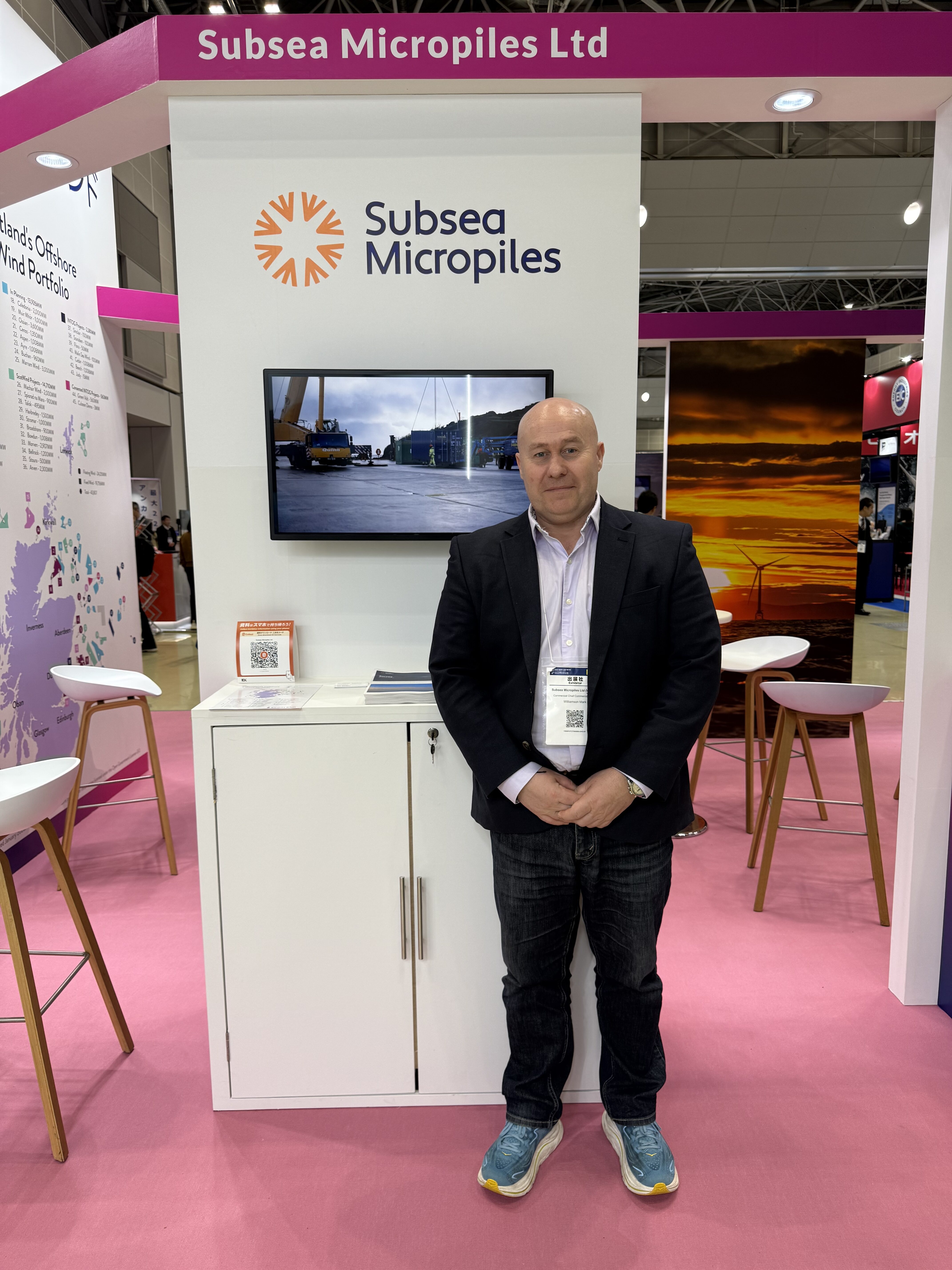
As Mark Williamson, CCO at Subsea Micropiles, notes, “Subsea Micropiles are close to the early movers in ScotWind floating projects offering differentiating survey and anchoring technology, which when demonstrated in ScotWind is likely to be adopted across the other two markets.
There is tremendous interest in our technology for both the Irish and Japanese markets already and having an Irish HQ and Japanese investors only adds to that alignment. They are very excited about how the Japanese offshore wind market will mature and want to align early with Subsea Micropiles to address that market, both for fixed and floating wind.”
After spending time in Japan Mark noted the momentum was reinforced at Wind Expo Tokyo, engagement was increasingly driven by EPC contractors looking for practical, scalable solutions for the local market, across both fixed and floating wind.
The direction of travel is clear. Offshore wind is no longer defined by who can bid lowest. It will be defined by who can deliver, across markets, conditions and technologies.